Superloop has been designed as part as competition project for Tallinn Architecture Biennale “Self-Driven City”. The project was awarded honorable mention.
This proposal is intended for time when autonomous cars will be 100% main city transportation. What will that mean for city streets and intersections?
Time is most valuable unit and humankind always are longed for doing most in less time. The goal to “travel to destination faster” is one of the main drive reasons for transport infrastructure evolution. Horses, bicycles, trains, cars, aircrafts etc. The efforts to reach this goal will guide the development of the technology and the city also in the times to come. Autonomous cars definitely will solve the more productive use of travel time itself, but this time after all won’t solve the base goal – “travel to destination faster”. Cities and roads that are adapted to autonomous cars can help to reach this goal.
As there will be no human error there will be no or very high speed limit. Today speed limit on city roads varies from 30- 50km/h. With only autonomous cars on roads speed limit could be 150km/h. If speed limit is that high, the only thing stopping cars are intersections. Autonomous cars have to slow down taking turn because of centrifugal forces acting on vehicle. Tires don’t have enough grip and car simply slips out of the turn or flips over. This is where superelevation comes in when designing roads.
Our proposal is aiming for intersection solution concept that is as fast as possible. Concept that can be adapted and used in every intersection no matter how much traffic lanes are intersecting. In that way there is no traffic jams and for the first time city can narrow car roads leaving more space for pedestrians and bicyclists.
Designer : Atis Sedlenieks


This intersection concept model is called the “SUPERLOOP”. It is extreme superelevated roundabout, with capability of supporting vehicles moving with speed up to 150km/h or possibly even faster, but Superloop is more than just a roundabout. Most of the intersections in the city have unused space above them, half of them also have unused space beneath. It is proposed to use this space for recreation above the intersection level and for car parking beneath ground. In this way Superloop can replace parking spaces that are otherwise distributed around the city and add more recreation space. Intersection becomes safer for pedestrians and bicyclers allowing them to cross it without interacting cars.
Every Superloop can be equipped with car parking lots beneath it. If vehicles are autonomous they would drop passengers off at destination, travel to closest Superloop and park there by itself. The core of the Superloop is filled with accumulators that collect energy from solar panels. The energy can be used to charge electric cars parked beneath. Solar panels are placed above recreation space. Recreation space above also protects roads from weather precipitation.
As in this particular intersection there are exchange of two different transports- trams and cars, we move nearest tram stops to the middle of the Superloop. From these stops there are stairs and three elevators that lead to the top recreation place. There are standard horizontal traffic lane for heavy trucks and busses placed right next to vertical, superelevated lane.
More images of Superloop Intersection for Self-Driving Cars:


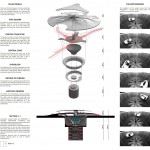
The inspiration for this concept comes from a motordrome – a carnival sideshow featuring a silo- or barrel-shaped wooden cylinder, ranging from 6 to 11 m in diameter, inside of which motorcyclists, or the automobiles, travel along the vertical wall and perform stunts, held in place by centripetal force.
Why exactly this solution? Is there no possibility to remove intersections and traffic lights leaving road crossings as vast squares where cars just avoid and bypass pedestrians and bicyclists? This solution is not possible for the solution mentioned in the beginning – “travel to destination faster”. When driving over flat square with pedestrians cars have to slow down because of the centripetal force. Humans even if are detected by cars system are unpredictable Someone can start to run, fall or just freeze still and this changes the bypass trajectory and speed and car have to slow down. Because of these reasons, it can be predicted that the next step to increase the speed and for decreasing the time needed to reach the destination is to isolate intersections and eliminate the need for slowing down.
Tuvie has received “Superloop Intersection for Self-Driving Cars” project from our ‘Submit A Design‘ feature, where we welcome our readers to submit their design/concept for publication.
Superloop Intersection for Self-Driving Cars by Atis Sedlenieks is originally posted on Tuvie - Modern Industrial Design