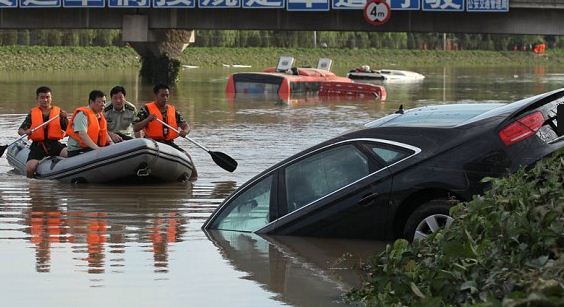
A rescue boat approaches a partially submerged car on a flooded highway after heavy rainfalls in Beijing

People wade across a flooded street in Beijing
As of Monday morning, nearly nine million users of China's popular Sina Weibo microblog had posted their fury at the absence of any official warnings, and at the failure of the city's outdated drainage systems to cope with Saturday's deluge.
"If the drainage system had been good, if the warning system had been put in place in a timely manner, if people had been told to stay home, would so many people have lost their cherished lives?" posted one, named Bijiexiang.
At least 25 people drowned in Saturday's rains, the heaviest to fall on the city since records began in 1951. Six died in housing collapses, five were electrocuted and one person was struck by lighting.
The rains and flooding caused 10 billion yuan (£1 billion) in damage, while nearly 66,000 people had to be evacuated from their homes, state media said, citing the Beijing government.
"Chinese cities are apparently unpractised in facing disasters such as Saturday's torrential downpour," the Global Times daily said in a Monday editorial critical of the city's disaster preparedness.
"If so much chaos can be triggered in Beijing, the capital of the nation, problems in urban infrastructure of many other places can only be worse."
Photos showed entire parking lots flooded, while rescue and traffic workers were seen diving underwater to unclog roadside drains as helpless drivers looked on from partially submerged cars.
Numerous roads in the capital were submerged under up to a metre (three feet) of water, while 500 outbound flights were cancelled and at least 80,000 passengers stranded.
On Monday, parts of the Beijing-Guangdong highway, a major arterial leading to the south, remained submerged, the Beijing traffic bureau said.
Some state-run media focused on how the rains brought the city together with police and traffic workers joining hands with ordinary citizens to rescue stranded motorists.
"It was fortunate that the rains came on Saturday," said a commentator on China Central Television. "If these floods happened during a work day the result would have been even worse."
According to a Beijing television report, in the worst of the downpours ordinary motorists offered free rides to those who were stranded, including some of the 80,000 travellers stranded at the airport after flights were cancelled.
But most web users took a more negative view.
"Beijing has been defeated by a huge rainstorm, the city's infrastructure has failed, there is nothing here to be proud of," posted one on Sina Weibo, under the name Zhulidemixu.
In neighbouring Hebei province, which surrounds Beijing, three people lost their lives in the downpours and one person was missing, reports said.
Meanwhile, the official Xinhua news agency reported torrential rains on Friday and Saturday left 17 people missing in north China's Shaanxi province, while eight people were confirmed dead due to heavy downpours in Sichuan province, in the nation's southwest.
China is routinely ravaged by summertime flooding, which normally wreaks havoc in regions along the central Yangtze river and in the nation's south.


