ON A REMOTE ISLAND in Papua New Guinea, scientists have uncovered the world's only known orchid to produce flowers exclusively at night that die by the next morning.
Of more than 25,000 species in the orchid, only a handful flower in the evening. The new orchid, dubbed Bulbophyllum nocturnum, is the first known one whose flowers shrivel and fall off before dawn breaks.
Dendrobium chrysopterum - discovered bybotanist Andre Schuiteman in 1990 in PNG and described by him and Ed de Vogel. Found only in the forests of Eastern New Guinea.
Bulbophyllum nocturnum is the first known orchid whose flowers bud at night and shrivel and fall off before dawn breaks.
Bulbophyllum xanthomelanon is a member of the section Epicrianthes, closely related to Bulbophyllum nocturnum. They resent disturbance and are difficult to cultivate.
Bulbophyllum tarantula. New species of the orchid family are found all the time. This relative of Bulbophyllum nocturnum was found recently by the same team of researchers and is endemic to PNG.
Bulbophyllum macrorhopalon. Found in New Guinea at elevations around 1800m, this orchid blooms in the autumn, a very short bloom with a single flower.
Bulbophyllum macneiceae - Also found in Papua New Guinea, this orchid is one of the 18 species of Epicrianthes endemic to the island.
Bulbophyllum johannuli. This rare member of the Epicrianthes section is found only in the Bismarck archipelago in PNG.
Bulbophyllum cimicinum. Also found in the Bismarck archipelago, this single-flower orchid needs dry seasons to survive.
In this amazing footage, taken by owner Christopher Geach, Casper is captured with his head almost fully submerged with only his snout sticking out above the water.
Mr Geach is rubbing doggy shampoo into his pet's almost white coat while his wife Emma films his adorable reaction.
Such is Casper's relaxation that he almost forgets to close his eyes as his head drops further into the water.
Mr Geach, 37, from Los Angeles, said: "Casper has a bath about once a week. Usually he will patiently sit or lay down on his stomach while I bathe him.
"On this particular day he was laying on his stomach and I lifted up on of his front paws to wash his belly and he just flipped over onto his back by himself. I began soaping up his underside and he was enjoying it so much he just let his head dip into the water until just his snout was showing.
The family bought Casper in November last year and give him almost weekly baths because he gets dirty so quickly.
"He began getting frequent baths right from the beginning because he seems to love sprinklers and muddy puddles,"said Mr Geach.
"I don't know why he loves it so much but it is adorable.
"Even when someone else is in the bath he will stand next to the tub and stare. Sometimes he will hang his head over the side and drink some of the water."
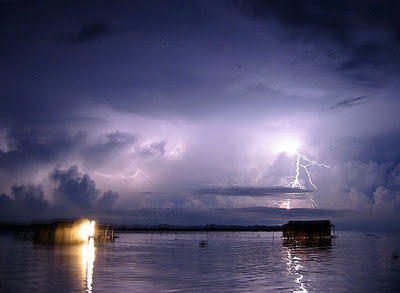
The mysterious "Relámpago del Catatumbo" (Catatumbo lightning) is a unique natural phenomenon in the world. Located on the mouth of the Catatumbo river at Lake Maracaibo (Venezuela), the phenomenon is a cloud-to-cloud lightning that forms a voltage arc more than five kilometre high during 140 to 160 nights a year, 10 hours a night, and as many as 280 times an hour.
This almost permanent storm occurs over the marshlands where the Catatumbo River feeds into Lake Maracaibo and it is considered the greatest single generator of ozone in the planet, judging from the intensity of the cloud-to-cloud discharge and great frequency. The area sees an estimated 1,176,000 electrical discharges per year, with an intensity of up to 400,000 amperes, and visible up to 400 km away. This is the reason why the storm is also known as the Maracaibo Beacon as light has been used for navigation by ships for ages.
In 1595 sir Francis Drake tried to attack the city of Maracaibo but the local defence caught sight of his ships thanks to the light from the storm. It is also said that Catatumbo lightening gave Almirante Padilla victory over the Spanish float during the independence war, on july 24 1823.
The collision with the winds coming from the Andes Mountains causes the storms and associated lightning, a result of electrical discharges through ionised gases, specifically the methane created by the decomposition of organic matter in the marshes. Being lighter than air, the gas rises up to the clouds, feeding the storms.
Some local environmentalists hope to put the area under the protection of UNESCO, as it is an exceptional phenomenon, the greatest source of its type for regenerating the planet's ozone layer.
Thames Town looks a lot like your average historic English village. There are lush green squares, classic brick homes, and even red telephone booths.
But Thames Town is not nestled in the British countryside; it's located in the northeast corner of China in Songjiang, near Shanghai.
And it didn't grow gradually over hundreds of years; it sprang up in 2006 as part of Shanghai's "One City, Nine Town" initiative, an attempt to decentralize the city.
The city is a virtual ghost town, with empty shops and unused roads.It's a popular destination for wedding photos.
Goldie, the sculpture that looks like a rusty, prone robot, lies mute on Woods Quad. This piece acknowledges the decline of industrialization in America. Specifically the iron industry of Birmingham, Alabama.
There was a big buzz about Russian station UVB-76 which was known as a "buzzer" transmitting repeating beeping signals for as long as 30 years, and then lately a few times those were interrupted with strange coded voice messages. Now you can have a rare chance to see the place from where all those are coming from.